Exciting News: We've expanded our network to 29 States and 7 Union Territories! Find a partner near you.

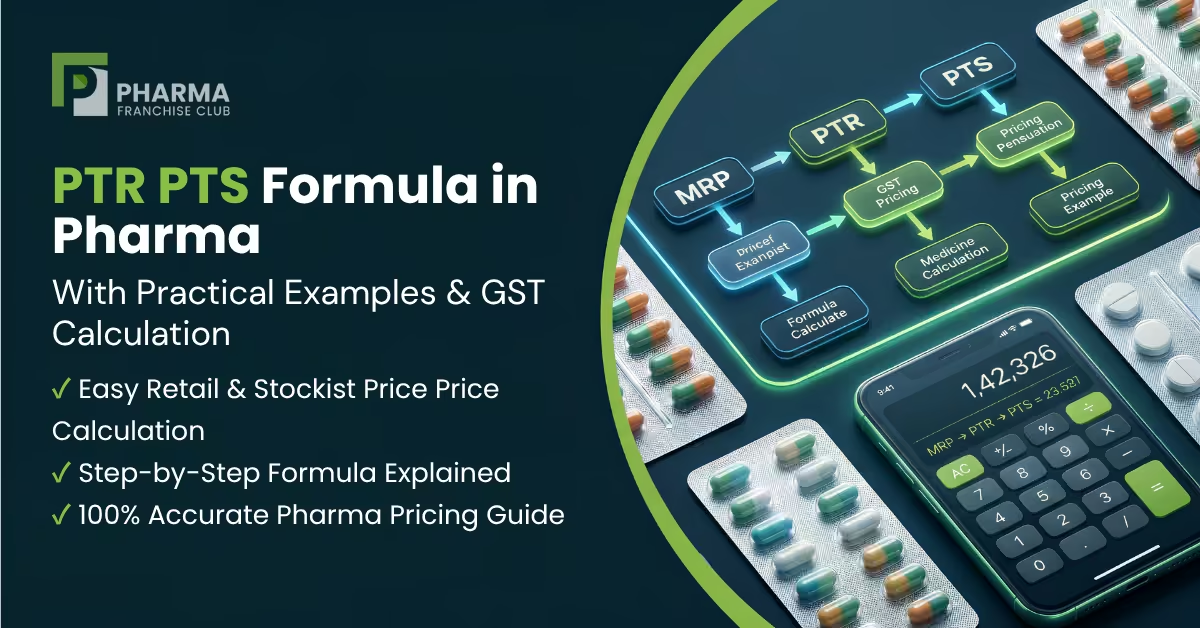
PTR PTS Formula in Pharma (How to Calculate PTR & PTS with GST)
PTR PTS Formula (Quick Answer)
The PTR PTS formula is used in pharma pricing to calculate distributor and retailer rates.
PTR (Price to Retailer) = PTS (Price to Stockist) + Stockist Margin.
Clear pricing fosters trust and safeguards margins in pharma business. This is why most companies learn about the PTR PTS formula prior to establishing rates. It states how the price is passed on between the company, the stockist, and the retailer.
Teams that understand how to calculate PTR PTS do not get confused and minimize billing errors. An effective pharma pricing formula also enables improved planning, negotiation, and profit control.
Simply put, PTR and PTS facilitate the establishment of an effective and transparent pricing system of the entire pharma distribution chain.
What is PTR PTS Formula in Pharma?
The PTR PTS formula is a pharma pricing method used to determine how product prices move from company to stockist and retailer. It helps maintain accurate margins and pricing consistency across the distribution chain.
PTR PTS Formula Explained
PTR = PTS + Stockist Margin
PTS = PTR – Stockist Margin
PTR Full Form
PTR stands for Price to Retailer. It is the price at which a retailer purchases medicines from a stockist.
PTS Full Form
PTS stands for Price to Stockist. It is the price at which a stockist purchases medicines from a pharma company.
What is the PTR Formula?
PTR is an abbreviation for Price to Retailer. It is the price at which a medicine is sold to a retailer by a stockist. This value is highly significant since it will directly influence retailer margins and downstream price control.
PTR is computed in most situations, having added retailer margin to the stockist’s purchase value. PTR, therefore, assists businesses in being aware of the next trade level price. PTR can be more easily estimated and checked when you use the PTR PTS formula. It also augurs communications in channels. So, PTR is a component of the pharma pricing model and daily rate.
PTR Formula:
PTR = PTS + Stockist Margin
What is the PTS Formula?
PTS is an abbreviation for Price to Stockist. It is the rate at which the company makes sales of the product to the stockist. This is the initial trade value in most price talks.
PTS assists in creating the foundation of supply chain margins as well as future calculations. In simple words, when the company price is falsified, all the subsequent rates can be false as well.
This is why PTS should be paid attention to. The formula for a practical pharma pricing will start with the correct PTS value. Subsequently, the businesses will be able to add retailer margins, compare net rates, and verify the overall market fit with greater confidence.
PTS Formula:
PTS = PTR – Stockist Margin
How to Calculate PTR and PTS in Pharma?
- Identify PTS (company selling price)
- Check stockist margin (%)
- Calculate margin amount
- Add margin to PTS → PTR
- Verify with MRP and net rate
It is not complicated when knowledge of how to calculate PTR PTS in the proper sequence is available. The initial point is to find out the PTS or company selling rate to the stockist.
Next, check the retailer’s margin percentage. Then, calculate the margin amount on the PTS value. Then, the retailer’s margin should be added to the PTS. The outcome is the PTR.
Lastly, make a comparison between the result with MRP and the net rate. This approach provides an understanding framework and minimizes errors.
Consequently, pricing will be more reliable. It is also used to assist teams in talking about rates in terms of numbers rather than estimates.
Along with basic calculation, GST also affects pharma pricing. Let’s understand how.
How to Calculate PTR and PTS in GST?
To calculate PTR and PTS with GST:
- Start with base PTS value
- Add stockist margin to get PTR
- Apply GST on MRP or transaction value (as applicable)
- Verify final billing value
Note: GST calculation may vary based on company pricing structure and billing method.
PTR PTS Calculation Example
Suppose a pharma franchise company sells one product to a stockist at ₹100. Here, ₹100 is the PTS. Now, suppose the retailer’s margin is 20%. To calculate the margin amount, multiply ₹100 by 20%. The result is ₹20. Then add ₹20 to ₹100. So, the PTR becomes ₹120.
Here is a simple application of the pharma pricing formula. It also demonstrates the way to calculate PTR and PTS without any misunderstanding. In the actual business environment, the discounts, schemes, or checks pertaining to taxes can also be part of teams. The fundamental thinking is simple and applicable even at that time.
If PTS = ₹100 and stockist margin = 20%:
Margin = ₹20
PTR = ₹120
Use PTR PTS Calculator for Accurate Pharma Pricing
✔ Instant calculation
✔ Error-free pricing
✔ Better profit planning
Common Mistakes in PTR PTS Calculation
A large number of pricing mistakes occur due to people failing to take one crucial step. Other users will input an incorrect margin by the retailer. Some mix up PTR and MRP or net rate.
Some teams do not remember to change the scheme value prior to finalizing rates. Calculations made manually also enhance the possibility of error. This is why any business must ensure that they check the base rate and then add the appropriate margin.
An effective pharma pricing formula will avoid confusion and time-wasting. It enhances internal accuracy as well. With the appropriate process, teams preserve margins, enhance billing quality, and foster greater trust throughout the pharma supply chain.
- Using incorrect margin percentage
- Confusing PTR with MRP
- Ignoring GST or scheme adjustments
- Entering wrong base value
PTR vs PTS vs MRP (Comparison Table)
| Term | Meaning | Level |
|---|---|---|
| PTS | Price to Stockist | Company → Stockist |
| PTR | Price to Retailer | Stockist → Retailer |
| MRP | Maximum Retail Price | Customer Level |
To calculate PTR and PTS instantly, use our PTR PTS Calculator Tool.
Quick Summary:
- PTR = Price to Retailer
- PTS = Price to Stockist
- Formula: PTR = PTS + Margin
- Used in pharma pricing system
- Helps calculate margins and profits
Generic Pharma Franchise Cost Guide
FAQs (PTR PTS Formula)
What is PTR PTS formula?
PTR = PTS + Stockist Margin.
How to calculate PTR and PTS?
Add stockist margin to PTS to get PTR.
What is PTR in pharma?
Price at which retailer buys from stockist.
What is PTS in pharma?
Price at which stockist buys from company.
Is GST included in PTR PTS?
GST may apply separately depending on billing structure.